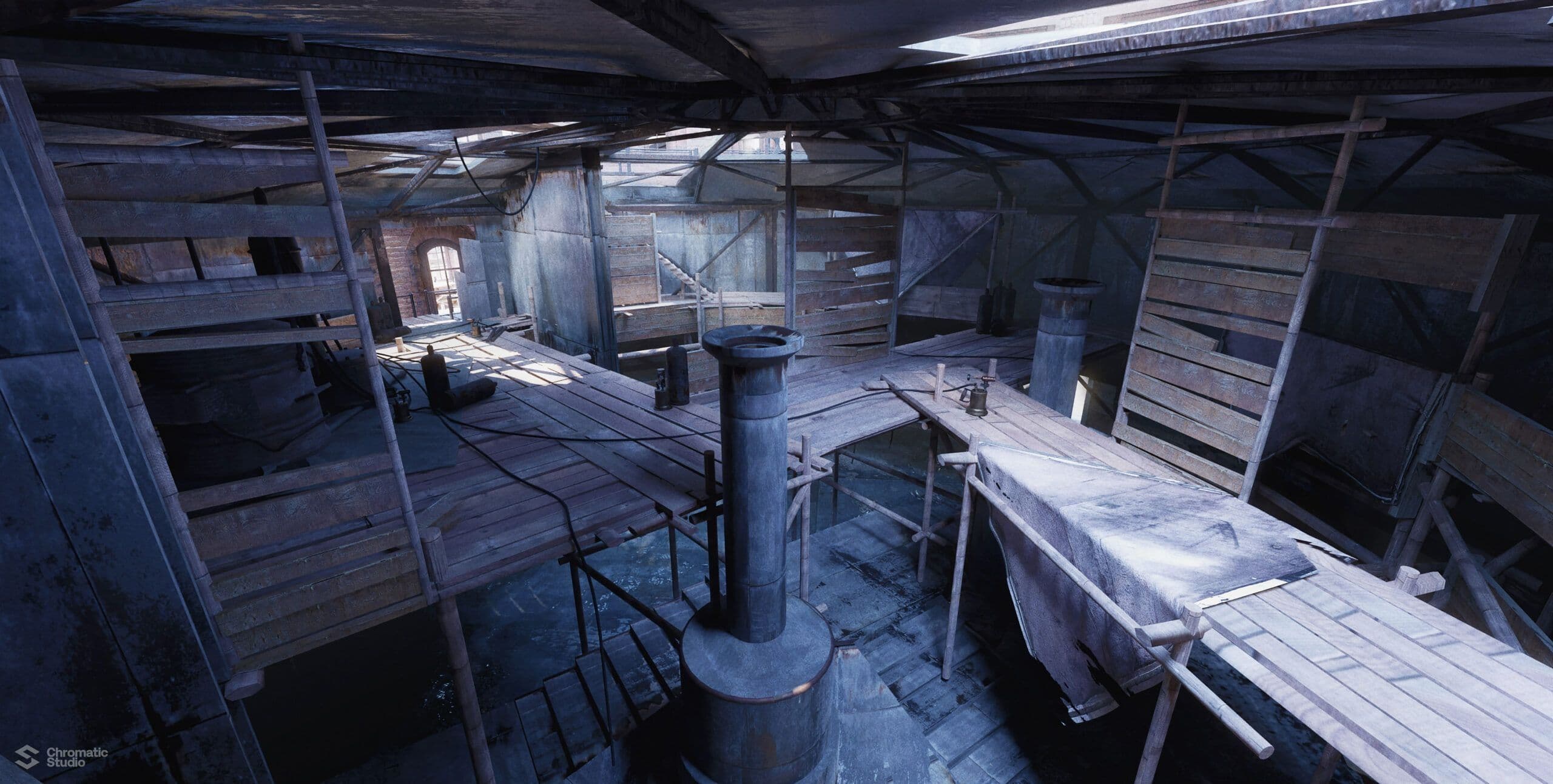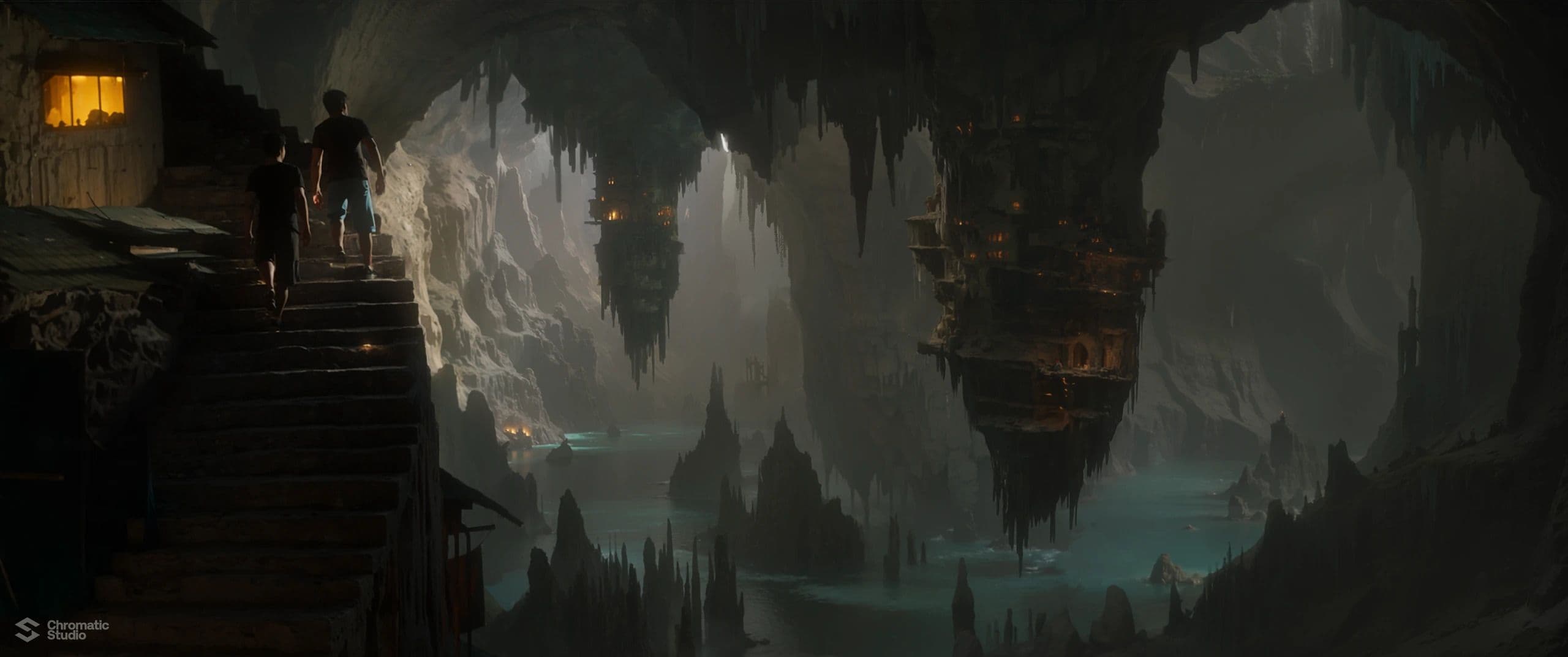
Crytek's Hunt: Showdown 1896 already had a strong, consistent art direction when we joined: grounded, late nineteenth century, built from timber, brick and iron. Our team, led by Art Director Simeon Schaffner, designed new locations and characters for the game's newer maps. The challenge was finding new ideas inside that world. Every place had to feel like it belonged in Hunt and still be worth exploring for players who already know the game well. Most of the environment concepts were built in 3D, and their job was the layout, the gameplay ideas and the landmarks of each location.
The Hunt: Showdown art style
Hunt's look is grounded in its period. Its buildings are made from what people had in the 1890s, mostly timber, brick and iron, and they look used: weathered, patched and built for a purpose. The horror sits in what has happened to these ordinary places. Working inside that style means every new design has to look like it could have been built at the time, and like people lived and worked in it before the players arrived.
That still leaves a lot of room. The period had dredges, foundries and gasometers, and each gives a map a shape and a set of spaces that players have not seen in Hunt before. Most of our new ideas came from finding buildings like these and working out how they would have been used.
Locations that fit 1896 and still feel new
For a location to feel like Hunt, it has to look like something people in the 1890s could have built and worked in. For it to be interesting, it needs something players haven't fought around before. The gold rush dredge does both. It is a working machine of the period, with its bucket ladder reaching into the excavation lake, and it gives the map a landmark players can spot from across the site.
3D environment concepts for layout and gameplay
Most of our Hunt environments were built as 3D concepts, not paintings. A 3D scene can be turned to the angles players will see it from, so the level team can judge distances, heights and lines of sight before anything is built in the game. It is also quick to change: moving a building or opening a new route is an edit to the scene rather than a new image.
These concepts are deliberately left unfinished. The most beautiful light and a cinematic frame are not their goal. What they settle is the layout of the site, the gameplay ideas it is built around and the landmark that makes it recognisable, such as the dredge at the gold rush mine. That is why the images here look like working designs. They were made to be used by the people building the map.
Planning a map location
Most of our Hunt locations started as an annotated overview of the whole site. A layout gives the level team something to plan with: where the boss building sits, how the parts of the site connect and what players see on the way in. Changes are quick to make at this stage, and the more detailed 3D views that follow are built on a plan everyone has agreed.
Large interiors get the same treatment. The cutaway of the railroad roundhouse shows its locomotive bays and turntable, so the level team can see how the building works inside before anyone builds it.
What a level team needs from concept art
For a level team, the useful part of an environment concept is what players will use to find their way, how they reach the site and what reads from a distance when someone is looking for cover or a target. A strong landmark and a clear approach help players work out where they are in the middle of a fight.
The overview of the riverside foundry is drawn from the rail-yard approach, so it shows the site the way players first see it, and the level team can judge the approach before anything is built.
Designing boss buildings
In Hunt, the boss building is where the bounty target waits, and where teams of players are most likely to meet. That makes it the most important space on a location. A good boss building needs more than one way in, interiors that give both attackers and defenders something to work with, and an outline players can pick out from across the map.
Several of our locations were built around one: the dredge at the gold rush mine, the barn on the corn farm and the workshop at the logging camp. Each is a working building of the period, which keeps it believable, and its layout is planned for the fight that will happen inside it.
Trying more than one version
Some locations needed several attempts before the strongest idea was clear. The chalk quarry went through versions built around a single towering block, a block turned into a fortress with walkways around its base, and rail track winding between the cut faces. Each version answers a different question: what players see from a distance, where they fight and how the stone left the site. Seeing the options side by side lets the client choose with the differences in front of them.
Interiors built for work
Hunt's interiors read as places where work happened, and that is a large part of what makes the world believable. Every room we designed was planned around its job, from the railroad roundhouse, where locomotives are lifted and taken apart, to the logging camp's carpentry workshop.
Designing for different times of day
Hunt is played at different times of day, from bright afternoons to dusk and night, so a location has to work in very different light. A space that reads clearly at noon can lose its landmarks, its routes and its cover once the light drops, and players notice that straight away in a fight.
We showed the gasometer at two times of day, so the team could see whether its routes and cover still read as the light changes. That matters most in an interior players fight through, because the light decides what they can see and where they can hide.
Hunt: Showdown characters
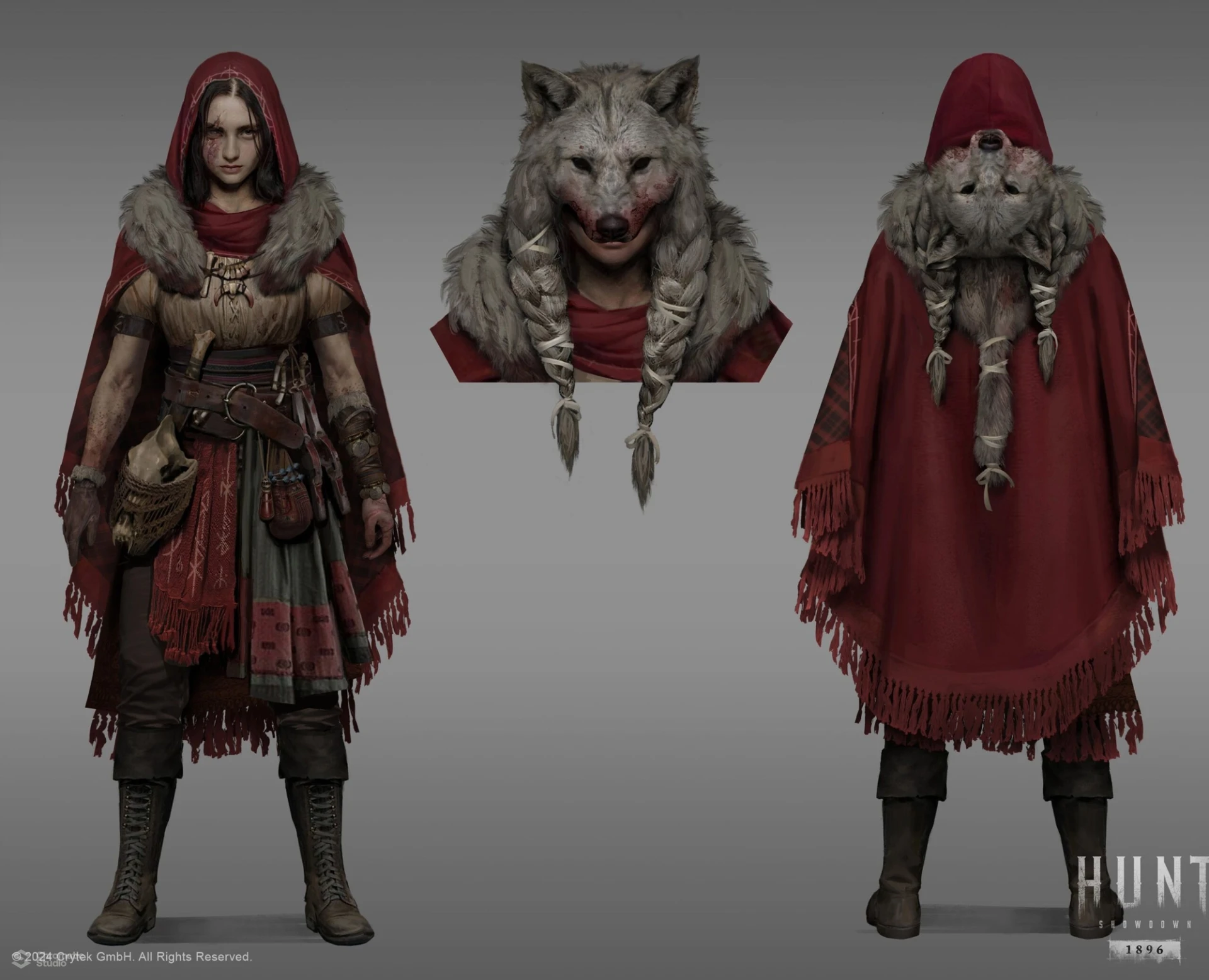
Hunt's characters come from the 1890s and from folk tales: a gunslinger, a Victorian girl and Red Riding Hood among them. Each keeps a shape you would recognise and adds one detail that makes it Hunt, such as The Fool's iron mouthplate, the revolver on Dorothy Alice's hip or the wolf pelt Red Riding Hood wears. The Fool was first drawn with a circus mask. The mouthplate is the version that fits the game.
Outline matters as much as detail. In Hunt, players often see each other at a distance, in fog or in poor light, so a bowler hat, a hood or a pumpkin helm needs to be recognisable long before a face is.
Dorothy Alice was explored in two quite different versions before her design settled. Final designs went to Crytek's modellers as character sheets showing each character front and back, with a close-up of the head, so nothing about the costume had to be guessed.
Concept art for a live game
Hunt has been updated for years, with new maps, events and hunters added along the way. Each addition needs concept art that matches what is already in the game and arrives in time for an update. That puts weight on two things: designs clear enough to build quickly, and consistency, so a building or a hunter added this year sits comfortably next to one from launch.
Who made the Hunt: Showdown concept art
Hunt: Showdown's look was set by Crytek's own art team, including the concept artists who designed its original bayou maps, hunters and monsters. Our team at Chromatic Studio, led by Art Director Simeon Schaffner, joined to provide game concept art for the newer maps of Hunt: Showdown 1896, designing locations and characters inside the art direction Crytek had already established.
The concept artists on the project were Jonathan Bertaud, Arthur Ripert, Stefan Toma, José Ramírez, Marc Meyer and Oscar Bagalini, with Kian Kazemi and Alvaro Lantero coordinating production.
If your game has an established look and needs new places or characters that belong in it, get in touch.